Jamie
The average Indian consumer uses about 31 GB of mobile data per month, which is more than the average user in North America and Western Europe. A decade ago, it would have been hard to believe that the mobile data usage in India would be so high.
The reason for the difference in data usage across these regions is the price and the infrastructure of the telecommunication networks in those regions and the demand for data in those regions. The same piece of hardware can produce a very different data footprint depending on where and how it is used.
In today’s world, smartphones are used to stream high definition videos and play high definition games, which require a lot of data and can strain the mobile network. Games and streaming services all have different data consumption profiles and can impact your data plan in different ways.
Online casinos are a great example. Slots and digital roulette do not use a lot of data, but live casino games can impact your data plan in a much bigger way.
A World of Different Data Appetites
Ericsson reported that the average data usage per smartphone increased from 5.6 GB in 2018 to 19 GB in 2024. The increase was mainly due to the increase in mobile data usage for streaming videos.
India has the world’s highest cell phone data consumption. The average monthly consumption in South Asia is about 32 GB. Cheap data is the main reason for high consumption. In India, the cost of 1 GB of data is about $0.09, which is the lowest in the world. During 2016, cell phone data prices in India declined drastically because Reliance Jio offered 4G data services at very low prices.
Other service providers also reduced their prices and offered discounts. Data remains inexpensive enough that users do not need to ration consumption. Because of affordable data, users do not restrict their data consumption and do not lower their video quality.
The situation in North America is quite different. There is ample 5G coverage. It is the first region where the number of 5G and LTE networks is equal. Both North America and India have mobile networks capable of handling demanding mobile content comfortably.
Europe’s Mobile Market and Casino Apps
Western Europe’s 5G adoption rate of 54% by the end of 2025 is indicative of large variations in 5G adoption rates and mobile data quality within the continent. Parts of Eastern Europe, in particular, still lag significantly. Mobile data quality differences in regulated markets are noticeable, especially when accessing live casino and mobile roulette apps. The difference between casino formats becomes tangible at https://swiper.ro/ro/.
The UK online casino landscape has regulations protecting players and ensuring fair play. UK rules apply to all online casinos targeting Britain, whether based there or not. Like the UK, Sweden also has an open and competitive online gaming market, particularly on mobile devices. Online gaming in Italy, especially casino games, has been popular for more than a decade.
Residents in the above mentioned countries have access to numerous casino games via mobile networks. Slots, roulette, and live casino games are available in all three markets. This raises the question: how much data is consumed by casino games? The answer, surprisingly, depends on the game format preferred by the player.
Slots: Lightweight by Design
Slots are perhaps the most data-efficient casino games. Upon opening a slot game, the device downloads game assets. For more graphically intensive games, the asset size and therefore the load time are greater. Compression reduces the size of audio files and other game assets.
Simpler games with minimal animation and simple artwork load much faster than graphically rich games. Generally, initial game downloads are within the 5 to 20 megabyte range.
The data footprint of slot games is surprisingly small. The phone sends a small message to the server for each spin to ask for the result. The server responds with a small message containing the result. The phone then displays the result. Spin animations are generated locally and do not require any server communication or data. Each spin uses very little data and one hour of gameplay uses between 1-5 MB of data. Many sessions use between 1 and 3 MB of data per hour of gameplay.
Of course, design choices made by developers of these apps lead to various business and user experience implications. In terms of data usage, the most intensive time for slot apps is the loading time. After loading is complete, the game requires relatively little ongoing bandwidth. The light server load allows the player to play the game for a long time without consuming a large amount of data.
As a result of the nature of mobile apps and the diversity of the hardware and software used by players, developers aim to keep the load and the computing needs of their apps as low as possible.
Digital Roulette: Smooth, Streamlined, Server-Side
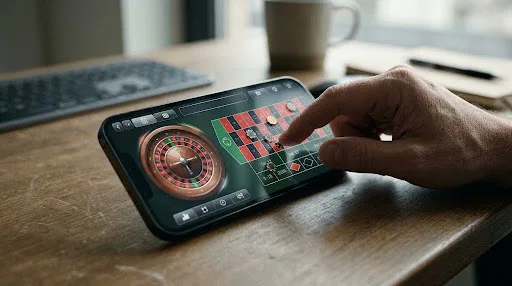
Digital roulette uses the same design concept as slot games. Interface differences increase the data footprint.
A roulette table has more active elements than a slot. The animation rotating the wheel is constantly looping, and the betting grid changes based on the chips placed on the table. A roulette game updates frequently, and changes state many times over the course of a single round.
The software that controls a roulette wheel changes state many times in quick succession, and processes many inputs from the player, all locally. Although all of this information is processed locally, a roulette game still generates and sends more data to a server than a slot.
The total data consumption of a digital roulette game is 10 to 30 MB per hour. Digital roulette requires more server communication and more advanced animations than a slot, and as such, uses more data than a slot.
Compared to a slot game, a roulette game requires a slightly better connection, and intermittent signal losses can temporarily disrupt the game state. The total data consumption of a roulette game is low enough that it doesn’t affect a player’s decision about where to play. On a decent 4G connection or better, digital roulette generally runs without issue.
Live Casinos: Data in a Whole New League
Live dealer games place real dealers in a studio and send real time video to players. Bets and game interactions are made in real time. From a data perspective, these games resemble online video streaming or video calls.
The live stream is the most crucial component of these games. Live streams can run at standard definition (SD) or high definition (HD). An SD stream is roughly 300 to 500 megabytes (MB) per hour. An HD stream, depending on the platform and quality setting, can reach 600 MB per hour or more. Manual or automatic settings change the quality of the stream.
Live casino games use a lot more data compared to traditional online casino games. For example, a one hour session of online slot games uses 2 MB of data. A live casino game in SD uses 150 to 250 times more data. A player can play video slots for an entire week using the data consumed by an hour of live casino games.
This is more than a theoretical exercise. Live casino is about as close as it gets to a real-world casino experience. Of course, this primarily refers to the presence of a live dealer, and the capture and streaming of various interactions and events from the gaming table. All of this relies on an efficient video stream.
In the absence of such a stream, or in the presence of a congested or inconsistent signal, the experience deteriorates. On the contrary, in the presence of a strong and consistent signal, either 4G or 5G, the experience is realistic and immersive. The main drawback of using mobile data for this experience is that, in a relatively short period of time, it quickly depletes a user’s data allowance.
North America: 5G and the Rising Standard
North American casino apps should see improved live casino stream performance on 5G as well. Live dealer streams in 5G-covered areas in major US cities can run in HD with minimal buffering. Generally, the data consumption is the same, but thanks to improved 5G networks, stream quality shouldn’t decline during use.
The same can be said for Canada. Thanks to improved coverage in urban and suburban areas of both countries, users should see improved stream quality and reliability in those areas. Users in less covered areas should expect stream quality similar to Europe where performance is dependent on the cell tower and signal.
North America has a range of data plan structures. With unlimited data plans, users have no incentive to choose slots over the live casino option to reduce data consumption. Preference plays the larger role. Users that have data limits or reside in regions where data is expensive are more vulnerable to data plan considerations.
India and Brazil: Huge Markets, Different Equations
The average smartphone user in India consumes around 31 GB of mobile data per month, and India has 365 million 5G users. India reached 365 million subscribers within 3 years of its 5G launch, representing 35% of the total user base and providing a large user base for data intensive mobile services. Mobile data speeds can have an impact on users’ experience while using data-intensive applications.
The cost of mobile data in India is relatively low. As a result, data volume may not be as big of a constraint for Indian users as it may appear from other countries. The quality of mobile data and signal coverage can impact the user experience. In urban areas of India with 5G coverage, online slot games, digital roulette and live casinos can work well. Users in regions with variable 4G coverage may face more problems with live casino.
As of the end of 2024, all of Brazil’s 5,570 municipalities could theoretically operate standalone 5G networks using the 3.5 GHz band. Average 5G download speeds in Brazil approach 350 Mbps where available. Although 5G networks have been rolled out in Brazil, in practice, users experience 5G coverage around 10% to 11% of the time, and the rest of the time users are on 4G.
As such, for mobile online gambling, the quality of 4G networks in Brazil is more relevant.
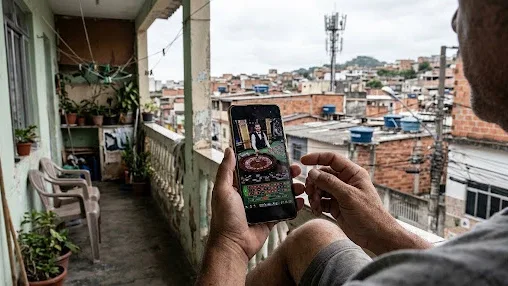
Factors That Impact Live Dealer Casino Games
Of all the gambling activities examined, live casino is the most affected by variability in network conditions. Video streams from these games require a continuous and strong data connection in order to maintain high resolution. When data connections are constrained, video streams may skip frames and (briefly) stall.
An individual located in London with a 5G connection and a user located in a mid-sized Brazilian city with a 4G connection both have the same online slot games. For slots, differences in connection quality and speed have little practical effect on the two users’ experiences. The 5G connection in London allows for higher resolution video streams. The 4G connection in the mid-sized Brazilian city may result in lower video resolution.
The speed and data allowance of a mobile plan are different aspects of a plan. A fast 5G connection with a cap of 10 GB would allow around 15 to 20 hours of live casino use in a month before the cap is reached. After the cap, the casino would still function, but on a slower, throttled connection.
An unlimited 5G plan would not impose the same data-cap ceiling. Other games such as digital roulette and slots would have little impact on an allowance or cap.
Numbers That Actually Matter
The above would be the case whether the player is in the US, Europe, Asia, or South America. The games function and use the same volume of data to operate regardless of location. The cost of mobile data would vary between markets. Connection reliability also varies by location. In markets with less reliable connections and a capped monthly data allowance, players would need to manage their data use.
People care about the difference between live casino and other games for two reasons. First, they are often grouped together when considered from the user’s perspective. Live casino belongs in the same data-use category as video calls and video streaming because all three generate substantial network traffic.
Second, from a network engineer’s perspective, the differences are large and cannot be bridged. The main reason for the gap is that a live casino stream is real video, while digital slots and roulette are not. This gap cannot be eliminated without changing what live casino fundamentally is.
This is evident when looking at different regions. In North America, unlimited high-speed mobile plans are common. Consequently, users there are not as mindful of data usage when switching between games. Users in other regions where data is more expensive may use game selection to manage their data usage. The differences between games may be the same across all mobile data networks, but the situations where they represent an issue may vary. Knowing these differences is important.