Jamie
JamieRemember the days when a smartphone update just meant prettier icons and maybe a new way to swipe your notifications away? Those days are officially in the rearview mirror.
With the global rollout of HyperOS 3.0, Xiaomi isn’t just giving your phone a facelift; they are giving it a nervous system.
We are witnessing the transition from a “smartphone”—a device that waits for your input—to an AI Agent, a partner that anticipates your needs before you even reach for the power button.
Beyond the Screen: The Philosophical Shift of HyperOS 3.0
For years, we’ve been stuck in the “App Era.” You want pizza? Open an app. Want to check your flight? Open an app. HyperOS 3.0 is designed to break those walls down. Xiaomi’s vision with this update is to move beyond the app drawer and into a world of “Fluid Intelligence.”
It’s a shift from a reactive tool to a proactive agent. Your phone is no longer just a slab of glass; it’s becoming an invisible concierge living inside the silicon.
Meet Xiaomi Miclaw: The “Brain” Inside the Machine
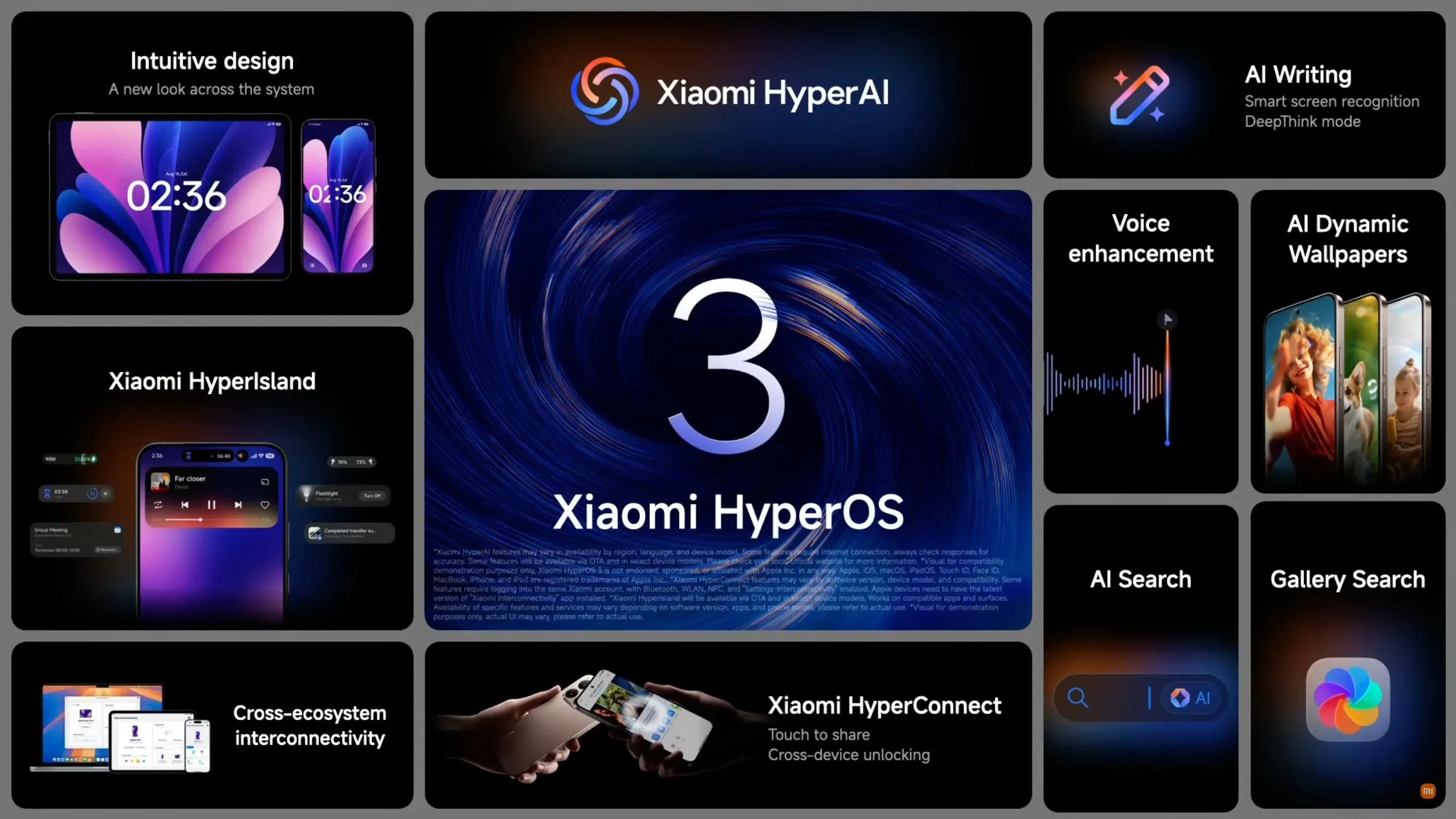
The star of the show isn’t a new widget; it’s Xiaomi Miclaw. This is the next-generation AI agent built on the MiMo Large Model.
Unlike the voice assistants of yesteryear that usually just set timers or told you the weather (often incorrectly), Miclaw is a “System Agent.”
From Voice Assistant to Autonomous System Agent
Think of the old XiaoAI or Google Assistant as a remote control. You had to press a button and give a specific command.
Miclaw, however, is more like a pilot. It has “System-Level Execution” capabilities. It doesn’t just talk to you; it interacts with the OS kernel to get things done.
MiMo Large Model: The Engine of Multi-Step Workflows
The real magic lies in multi-step workflows. Because it is powered by the MiMo model, Miclaw understands context. It can string together complex tasks that would usually take you five minutes of tapping.
It’s like having a digital intern who knows exactly how you like your spreadsheets organized and which emails are actually worth your time.
Practical Magic: Handling Your Bills and Calendar Silently
Imagine this: You receive a digital subscription bill via email. In the past, you’d open the email, sigh at the price, and maybe go to a browser to cancel it.
In HyperOS 3.0, Miclaw identifies the bill, cross-references it with your usage patterns, and sends you a subtle notification: “You haven’t used this streaming service in three months.
Should I cancel it for you?” Or, it might see a meeting on your calendar and autonomously mute your phone, set an “Out of Office” reply, and prep a summary of the attendees—all without you lifting a finger.
The Death of Traditional Search: Enter GEO and AEO
This is where things get spicy for the tech-savvy. We are moving away from SEO (Search Engine Optimization) and toward GEO (Generative Engine Optimization) and AEO (Answer Engine Optimization).
Deep Think & Universal Search: Bypassing the Browser
With features like “Deep Think” integrated into Notes and “Universal Search” baked into the home screen, Xiaomi is training you to stop Googling. Why go to a browser and scroll through ten blue links (and five ads) when your OS can give you a synthesized answer instantly?
By pulling data directly from the web and summarizing it through the MiMo model, HyperOS 3.0 is effectively acting as an ‘Answer Engine.’ However, this doesn’t mean the browser is dead—it’s just evolving.
While many tech enthusiasts still rely on a VPN extension for Google Chrome to bypass regional restrictions or secure their desktop browsing, Xiaomi is trying to bring that same level of utility and security directly into the mobile OS layer.
The goal is to make ‘Universal Search’ so secure and robust that you won’t feel the need to jump into a browser for your daily queries.
Why SEO is Dying and GEO is the New King for Techies?
By pulling data directly from the web and summarizing it through the MiMo model, HyperOS 3.0 is effectively acting as an “Answer Engine.”
For creators and marketers, this means the old rules of keyword stuffing are dead. For you, the user, it means a cleaner, faster experience. You ask, the OS answers. The middleman—the browser—is being evicted.
Hardware Meets Software: The Xiaomi 17 Max Connection
You can’t run a genius-level AI on a potato. This is why the hardware leaks surrounding the Xiaomi 17 Max are so crucial to the HyperOS 3.0 story.
The 8,000mAh Powerhouse: Fueling the AI Revolution
Running large language models (LLMs) on-device is a battery killer. The rumors of a massive 8,000mAh silicon-carbon battery in the upcoming Xiaomi 17 Max aren’t just for bragging rights; they are a necessity.
To keep an AI Agent active 24/7 without your phone turning into a brick by noon, you need that extra density.
HyperOS 3.0 uses AI-driven power management to ensure that this massive tank of energy is sipped, not gulped.
Liquid Engine 2.0: Technical Fluidity at Its Peak
To make the AI feel “alive,” the UI needs to be instant. Xiaomi’s Liquid Engine 2.0 provides a reported 21% boost in app startup speeds.
When you combine the Snapdragon 8 Elite (Gen 5) with this optimized software, the “lag” we’ve come to accept in Android becomes a relic of the past. It’s smooth, it’s buttery, and it’s fast enough to keep up with the speed of thought.
Privacy at the “Edge”: Keeping Your Data in Your Pocket
The biggest concern with AI is always: “Who is reading my data?” Xiaomi addresses this with their Edge-to-Cloud privacy framework.
The Edge-to-Cloud Framework: How Xiaomi Protects Your Life
Unlike some competitors that ship every request to a server in the cloud, HyperOS 3.0 prioritizes “Edge Computing.”
This means the most sensitive “thinking” happens locally on your device. Your personal habits, your messages, and your calendar stay in the secure enclave of your phone.
The NPU’s Role: Why On-Device AI is a Privacy Win
Thanks to the beastly NPU (Neural Processing Unit) in modern Snapdragon chips, Miclaw doesn’t need to “call home” to understand your intent.
By processing your data locally, Xiaomi mitigates the risk of data breaches and addresses the “Chinese server” anxiety that some global users feel. It’s your AI, on your silicon, under your control.
HyperOS 3.0 vs. Apple Intelligence: A Battle of Philosophies
Apple is doing some cool things with “Apple Intelligence,” but Xiaomi’s approach in HyperOS 3.0 feels more integrated.
While Apple focuses on making Siri slightly less annoying within specific Apple apps, Xiaomi is building a “System Agent” that isn’t afraid to reach into third-party services to get the job done.
System-Wide Integration vs. App-Based Silos
Xiaomi’s open-ecosystem DNA means Miclaw is designed to play well with others. Whether it’s controlling your non-Xiaomi smart home gear or managing third-party finance apps, the “Agentic” nature of HyperOS 3.0 feels like it has more “permission to act” than the often-gated garden of iOS.
The “HyperIsland” Experience: Notifications with a Soul
We have to mention the HyperIsland. It’s Xiaomi’s take on the Dynamic Island, but with a twist. It isn’t just a place for music controls; in version 3.0, it’s the “Live Activity” hub for your AI Agent.
If Miclaw is performing a background task—like monitoring a price drop or tracking a package—the HyperIsland expands to give you a “glanceable” update. It makes the phone feel like it’s breathing and working even when you aren’t looking at it.
Conclusion: The Post-App Era is Finally Here
HyperOS 3.0 is a line in the sand. It tells us that the era of the “app-based smartphone” is ending. We are entering the era of the Ambient Agent. Your Xiaomi 17 or Redmi K100 isn’t just a phone anymore—it’s a digital extension of your brain. It learns, it predicts, and it acts.
As we move toward a world where we talk to our devices and get instant, synthesized answers, the traditional way we use tech is evaporating.
Xiaomi isn’t just catching up to the competition; with the AI Agent revolution, they might just be leading the pack into a post-search, post-app future.
FAQs
1. Is HyperOS 3.0 coming to older Xiaomi devices?
Yes, but with a catch. While many devices like the Xiaomi 14 and 15 series will get the update, the advanced “Agentic” AI features (like Miclaw’s multi-step workflows) require the high-end NPU power found in the Snapdragon 8 Gen 3 and newer.
2. Does Xiaomi Miclaw work outside of China?
Currently, the full “Miclaw” experience is being perfected in the China ROM. However, the global version of HyperOS 3.0 includes “Google Gemini” integration and Xiaomi’s own “HyperAI” tools, which offer similar—though slightly more localized—functionality.
3. Will the 8,000mAh battery make the phone too heavy?
Thanks to silicon-carbon anode technology, these batteries are much denser but not significantly heavier or thicker than traditional lithium-ion batteries. The Xiaomi 17 Max is expected to be large, but not uncomfortably heavy.
4. Can I turn off the AI features if I’m worried about privacy?
Absolutely. Xiaomi includes a “Privacy Lab” within HyperOS 3.0 settings where you can toggle on-device AI vs. Cloud AI and completely disable the Miclaw agent if you prefer the classic smartphone experience.
5. How does “Liquid Engine 2.0” affect gaming?
It’s a game-changer. By optimizing how the OS allocates resources to the GPU and CPU, Liquid Engine 2.0 reduces micro-stutters and improves sustained frame rates in heavy titles like Genshin Impact or Warzone Mobile.