Jamie
Jamie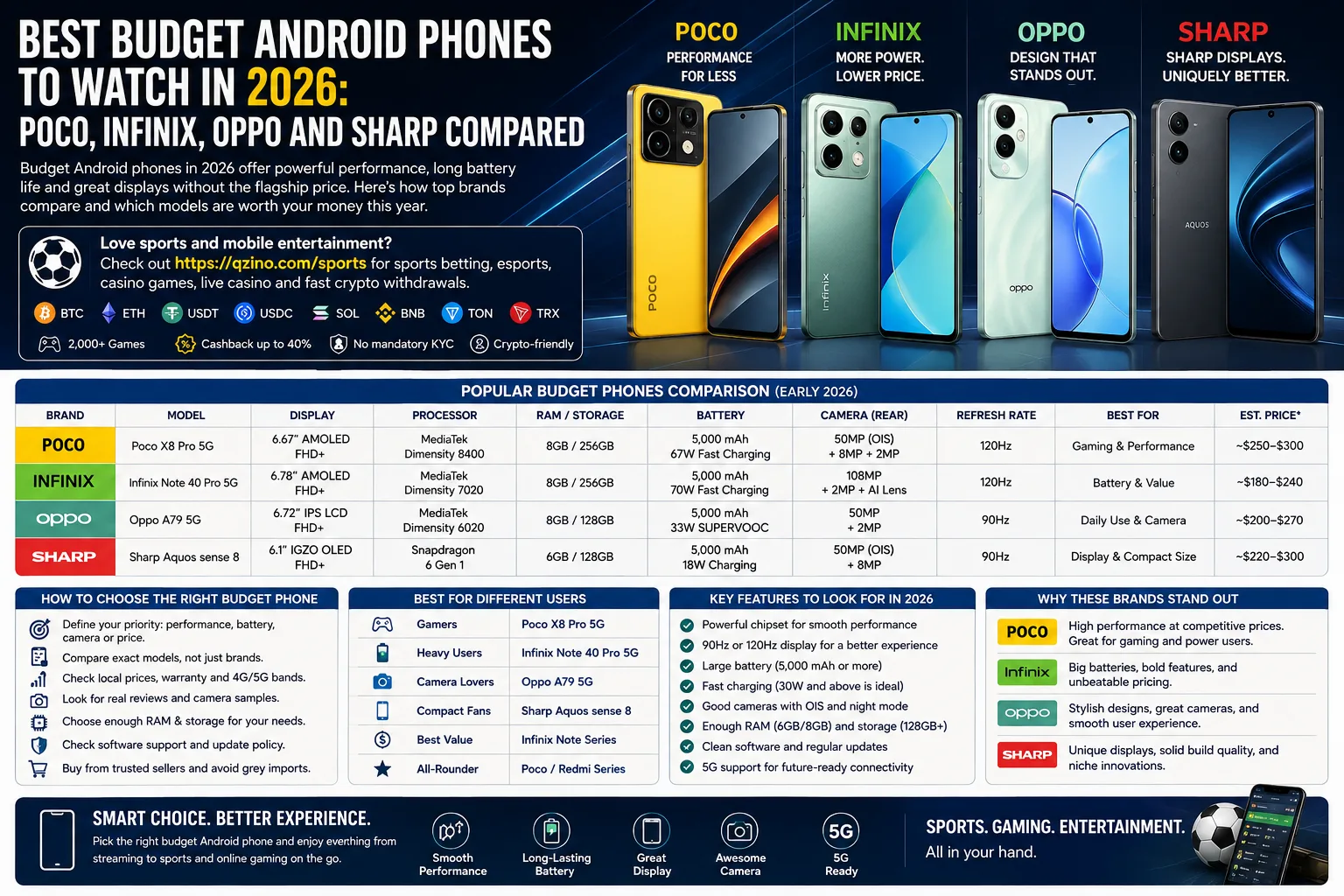
Budget Android phones are no longer only about basic calls, messaging and simple browsing. In 2026, affordable phones can offer large displays, strong batteries, smooth refresh rates, decent cameras and enough performance for gaming, streaming and everyday entertainment. That makes the budget category one of the most competitive parts of the smartphone market.
Brands such as Poco, Infinix, Oppo and Sharp attract different types of users. Poco is often known for performance value, Infinix for aggressive pricing and big batteries, Oppo for design and camera-friendly software, while Sharp is more niche but interesting for display and hardware-focused users in selected markets.
Mobile entertainment has also changed how people choose phones. A budget Android device is now used for streaming, social media, esports, live scores, browser games and online platforms.
For adults interested in sports-focused digital entertainment, https://qzino.com/sports offers sports betting, esports, casino games, live casino, fast crypto withdrawals and crypto-friendly payments in one platform.
Qzino supports BTC, ETH, USDT, USDC, SOL, BNB, TON and TRX, offers 2,000+ games, no mandatory KYC for standard access, cashback up to 40% and a broad mix of online gaming categories.
For users who want fast access to sports and entertainment from a mobile browser, a reliable Android phone with good battery life, screen quality and stable performance can make a real difference.
Why Budget Android Phones Matter in 2026?
Budget Android phones matter because many users no longer want to spend flagship-level money to get a good daily experience. A well-chosen affordable phone can handle messaging, video calls, social apps, maps, streaming, casual gaming and online browsing without feeling outdated.
The category is also improving quickly. Higher refresh-rate displays, faster charging, larger batteries and better chipsets are now common even below premium pricing. This gives users more freedom to choose value over brand status.
However, budget phones still come with trade-offs. Cameras may struggle in low light, software support may be shorter, and gaming performance may vary. The best choice depends on what matters most: battery, screen, camera, gaming or price.
Poco, Infinix, Oppo and Sharp: Quick Comparison
| Brand | Main Strength | Best For | Possible Trade-Off |
| Poco | Performance for the price | Gaming, multitasking, heavy apps | Software may feel busy for some users |
| Infinix | Low price and large batteries | Students, streaming, long daily use | Camera and updates can vary by model |
| Oppo | Design, cameras and user-friendly software | Social media, casual users, stylish phones | Performance value may depend on region |
| Sharp | Display quality and niche hardware | Users who like unique screens and compact options | Availability can be limited outside key markets |
| Xiaomi / Redmi | Strong value across many price tiers | Balanced budget and mid-range buyers | Regional model names can be confusing |
| Motorola | Clean software and practical pricing | Users who prefer simple Android experience | Camera performance can be average |
| Samsung A-series | Brand trust and longer support | Users who want stability and service access | Specs may cost more than rivals |
| Nothing / CMF | Design and clean software | Users who want style and simplicity | Availability and repair support vary by market |
Poco: Best for Performance-Focused Buyers
Poco is usually one of the first brands budget buyers consider when performance matters. Many Poco phones focus on strong chipsets, high-refresh displays and large batteries, which makes them attractive for gaming and multitasking.
This is especially useful for users who play mobile games, stream sports, switch between apps or use their phone as a main entertainment device. A smoother chipset can keep the phone feeling fast for longer, even if the design is less premium than a flagship.
The main thing to check with Poco is software preference. Xiaomi’s HyperOS can offer many features, but some users may find it heavier than cleaner Android interfaces.
If performance matters more than minimal software, Poco can be a strong value pick. Recent budget and mid-range phone roundups continue to highlight Poco models for value and gaming performance, including the Poco X8 Pro in 2026 buying guides.
Infinix: Best for Big Battery and Low Price
Infinix is a strong option for buyers who want a large screen, big battery and low price. The brand is popular in many emerging markets because it often delivers practical specs at aggressive prices.
For students, commuters and heavy video users, Infinix can make sense. A large battery is useful if you spend hours on YouTube, TikTok, messaging, football scores, browser games or streaming apps. Some models also offer fast charging, which is important for users who do not want to stay plugged in for long.
The trade-off is consistency. Some Infinix models are excellent for the price, while others may compromise on cameras, software polish or long-term update support. Always check the exact model, not only the brand name.
What to check before buying an Infinix phone:
- Battery capacity and charging speed
- Display resolution and refresh rate
- Chipset performance for your games or apps
- Available RAM and storage version
- Software update policy in your region
- Camera samples from real reviews
- 4G/5G band support for your carrier
Oppo: Best for Design and Everyday Usability
Oppo phones are often a good choice for users who care about design, camera features and an easy daily experience. The brand tends to focus on polished hardware, stylish finishes and user-friendly software.
For casual users, Oppo can be more comfortable than performance-heavy brands. If your main activities are messaging, photography, social media, streaming and browsing, a well-priced Oppo model can feel balanced and pleasant to use.
However, Oppo’s best value depends heavily on the region and model. Some budget Oppo phones are excellent, while others may not offer the same performance-per-dollar as Poco or Redmi. Before buying, compare the chipset, display and battery against similarly priced alternatives.
Sharp: Best for Niche Buyers Who Care About Displays
Sharp is not always the first brand people think of when shopping for a budget Android phone, but it has a unique place in the market. In some regions, Sharp phones are known for interesting displays, compact designs or unusual hardware choices.
A Sharp device may be worth watching if you like something different from the usual Xiaomi, Samsung, Oppo or Motorola options. Display quality can be a key selling point, especially for users who watch videos or read a lot on their phone.
The biggest issue is availability. Sharp phones are not equally easy to buy everywhere, and support can depend on the market. If the price is good and the model is officially supported in your region, it can be an interesting alternative.
Best Budget Android Phones for Gaming and Streaming
For gaming and streaming, the most important features are chipset, screen, battery and heat management. A phone with a weak processor may run casual games, but it can struggle with demanding titles, high frame rates or long sessions.
A high-refresh display can make scrolling, gaming and sports apps feel smoother. Battery life is also essential, especially if you watch live matches, esports streams or long videos away from home.
Audio quality and connectivity matter too. Stereo speakers, good Wi-Fi performance and reliable mobile data can improve the entertainment experience. Budget phones vary a lot in these areas, so reviews are useful before buying.
Best features for mobile entertainment:
- Strong chipset for the price
- At least 6GB to 8GB RAM for smoother multitasking
- 90Hz or 120Hz display if possible
- Large battery, ideally around 5,000 mAh or more
- Fast charging support
- Good Wi-Fi and mobile network compatibility
- Enough storage for apps, games and videos
- Comfortable screen size for streaming
Best Budget Android Phones for Cameras and Social Media
For social media users, the main camera matters more than the number of lenses. A phone with one good main sensor is often better than a phone with several weak extra cameras. Portrait mode, night mode and video stabilization can also make a big difference.
Oppo is often strong in this area because many of its phones are designed around lifestyle photography and easy camera modes. Infinix can also offer good value in some models, while Poco may focus more on performance than camera quality.
If you care about photos, do not rely only on megapixels. Look for real camera samples, low-light tests and video reviews. Budget phone cameras can look good in daylight but struggle indoors or at night.
Software, Updates and Long-Term Value
Software support is one of the biggest differences between budget phones. Some brands promise several years of updates, while others offer shorter or less predictable support. This matters because updates help with security, app compatibility and long-term usability.
Samsung and Google are often praised for stronger update policies in the Android market, while many budget-focused brands vary by model and region.
Tech Advisor notes that budget Android buyers in 2026 should pay attention to price limits, software experience and long-term value, not only headline specs.
Bloatware is another factor. Some phones come with extra apps, ads or duplicated services. These can sometimes be disabled, but they still affect the first impression.
If you prefer a clean experience, Motorola, Nothing / CMF or Google Pixel A-series models may be worth comparing alongside Poco, Infinix, Oppo and Sharp.
How to Choose the Right Budget Android Phone?
The best budget Android phone is not always the one with the highest specs. It is the one that matches your real use. A student may need battery and price. A gamer may need chipset and cooling. A social media user may need camera and storage. A sports fan may need a bright screen and stable connectivity.
Before buying, decide which three features matter most. Then compare models within your region. Phone names, prices and specs can change by market, so a global recommendation may not always be perfect locally.
It is also smart to read recent reviews before purchase. Budget phones can look similar on paper, but real-world performance, camera quality and software experience may differ.
Quick buyer checklist:
- Choose your main priority: gaming, camera, battery or price
- Compare exact models, not only brands
- Check local price and warranty
- Confirm 4G/5G band support
- Look for real battery and camera tests
- Avoid paying extra for weak “bonus” cameras
- Check update policy and software reputation
- Make sure storage is enough for your apps
Final Thoughts
Poco, Infinix, Oppo and Sharp all serve different parts of the budget Android market. Poco is strong for performance-focused buyers. Infinix can be excellent for price and battery life. Oppo often appeals to users who want design and camera-friendly features. Sharp is more niche, but interesting for display-focused users in certain regions.
In 2026, the budget Android category is stronger than ever, but it is also crowded. The best phone depends on the exact model, local price and your personal priorities.
If you want a device for mobile entertainment, look beyond the brand name. Check screen quality, battery life, processor performance, storage, updates and connectivity. A smart budget phone choice can deliver a smooth everyday experience without flagship pricing.